
Planning a walk-in closet: the measurements that matter
A good closet is mostly a question of millimetres: how long your coats are, how deep a shelf needs to be, how much room you need to turn around. These are the numbers we start from.
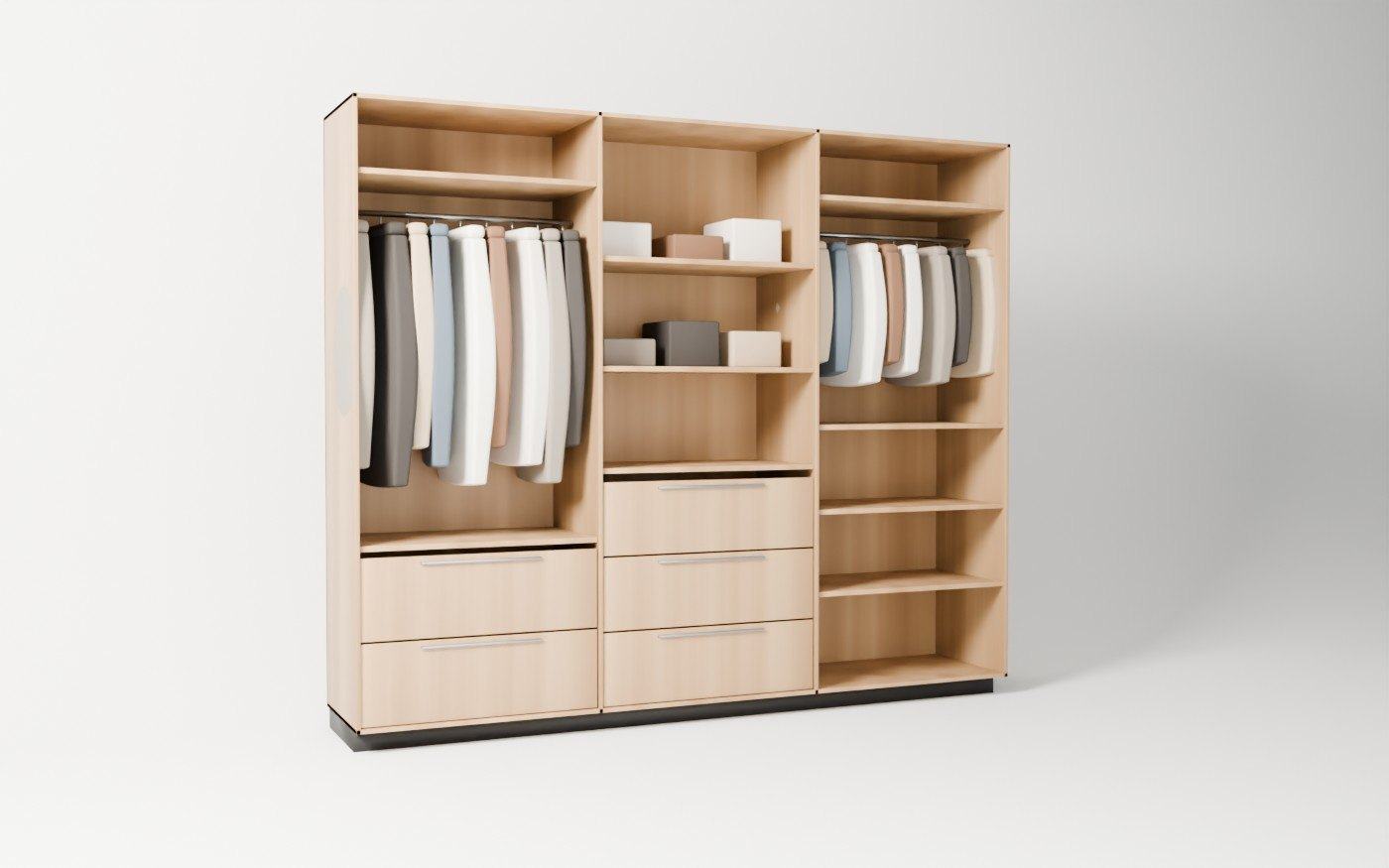
Start with what you own
Before anyone draws a line, count. How many long coats and dresses? How many shirts and jackets? How many pairs of shoes, and how many of those are boots? A closet designed around what you actually own works far better than one designed around a picture.
The figures below are the starting points we use. Every room and every wardrobe is different, so your drawing is always made to your space and your things.
Hanging
- Long hanging for coats and dresses needs about 1 600 to 1 700 mm of clear drop below the rail.
- Double hanging for shirts, jackets and folded trousers puts one rail at around 2 000 to 2 100 mm and a second at around 1 000 mm.
- Depth: a hanger is roughly 450 to 500 mm wide, so hanging sections are usually about 600 mm deep.
Shelves and drawers
- Folded knitwear sits well on shelves around 350 mm deep, spaced about 250 to 300 mm apart so stacks do not topple.
- Shoes: most fit on shelves spaced 180 to 200 mm apart; boots need more. Angled shelves with a lip show shoes off and make them easier to see.
- Drawers for accessories, watches and jewellery work best shallow, around 80 to 100 mm, with dividers or lined trays.
Room to move
For a walk-in closet with storage on both sides, an aisle of around 900 to 1 200 mm lets you open drawers and still move comfortably. If there is room for an island in the middle, it becomes the place you lay things out, and the natural home for watch winders and jewellery drawers.
Light and finish
Closets are where colour matters most: you are choosing what to wear. Neutral light, around 3 500 to 4 000 K, shows clothes truthfully; warmer light suits a dressing room that doubles as a bedroom. Light set into shelves and rails, rather than one ceiling fixture, removes the shadows that make things hard to find.
Inside finishes are worth thinking about too. Dark walnut and black feel rich and calm; natural oak and taupe feel lighter and show the colour of what you own.
Try it on the Halden
Our Halden cabinet lets you open the doors, change the interior finish, add watch winders, a jewellery drawer, shoe display or pull-out mirror, and change the colour of the light. It is a good way to see what you like before we draw yours.